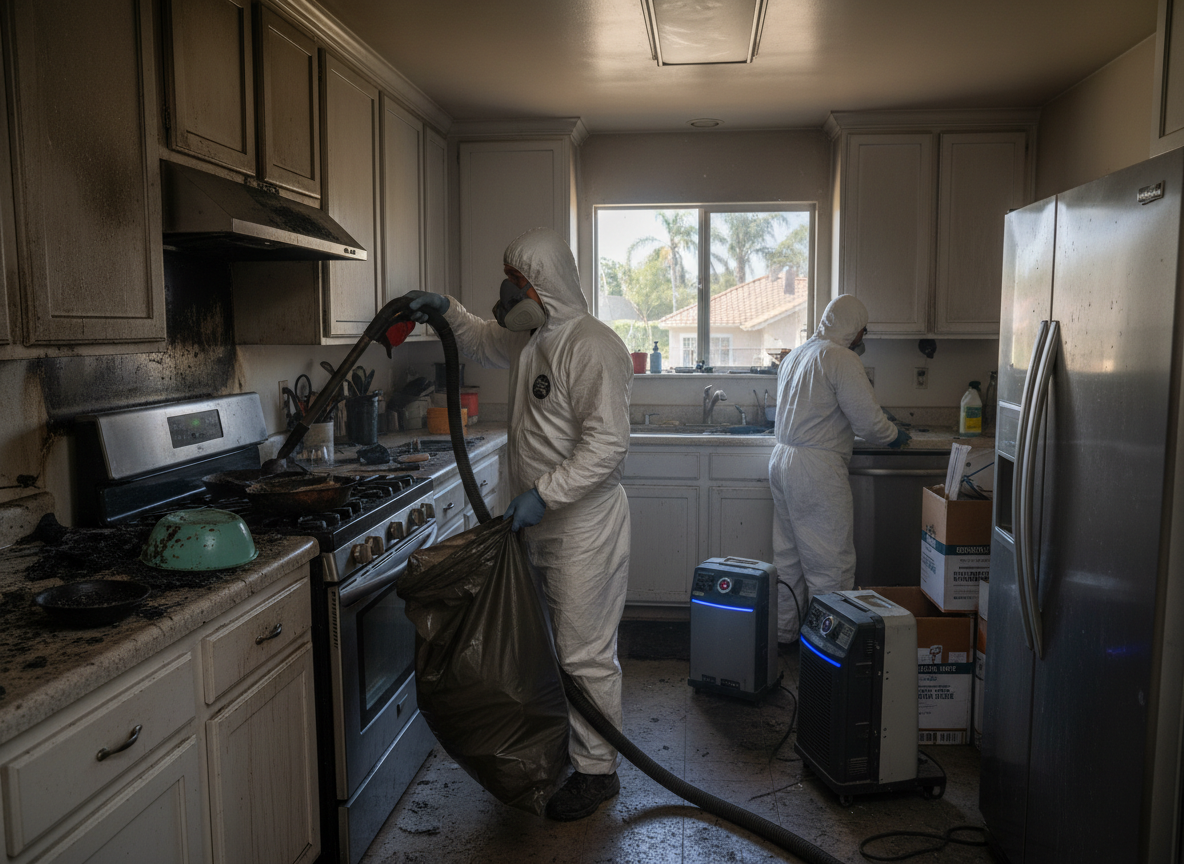
Kitchen fires in Encino often start on older gas ranges in ranch-style homes built in the 1950s and 1960s. These structures feature plaster walls and limited attic insulation that allow smoke to travel into wall cavities and under hardwood floors. Hot-summer Mediterranean conditions with low humidity accelerate soot adhesion on surfaces, requiring specialized alkaline cleaners to avoid etching tile or cabinetry finishes found in Lake Encino and South Encino neighborhoods.
Los Angeles County building codes require removal of all charred materials before re-insulation or drywall replacement. Technicians must also address grease-laden residues that bond differently on Formica versus natural stone counters common in Tarzana-adjacent properties. Failure to clean behind appliances or inside range hood ducts leaves lingering odors that return when fall winds pick up through the Sepulveda Pass.
Portable air scrubbers with HEPA and carbon filters run continuously for 48 to 72 hours after initial demolition. This step prevents redistribution of fine particulates into living spaces near Encino Park. Crews also test for hidden moisture from suppression water that can pool in slab foundations typical of Woodland Hills border homes, where clay soils slow natural evaporation.
Technician insight
In Encino the thing that catches most people out with kitchen fire cleanup is how quickly smoke travels through the shared attic spaces of 1960s ranch homes along Ventura Boulevard, especially when the dry summer air keeps everyone sealed inside with the AC running.
Kitchen Fire in South Encino Ranch Home
A grease fire spread from the range into the range hood and ceiling joists. We found heavy soot throughout the open living area and into the HVAC trunk line. Crews removed charred drywall and insulation, cleaned all surfaces, and ran air scrubbers for three days before handing the home back odor-free.
How it works
- 1
Site Assessment
Inspect kitchen, adjacent rooms and HVAC returns for soot migration and hidden char in Encino ranch homes.
- 2
Containment and Air Filtration
Set up plastic barriers and negative air machines to protect living areas from cross-contamination.
- 3
Residue Removal
Apply pH-specific cleaners to walls, cabinets and ductwork while removing unsalvageable materials.
- 4
Drying and Odor Neutralization
Deploy dehumidifiers and ozone or hydroxyl generators to treat porous surfaces before reconstruction.
- 5
Final Clearance
Conduct visual and odor inspection with homeowner walkthrough prior to any rebuild work.
Pricing
Upfront written quotes after on-site inspection; final cost driven by square footage affected, HVAC involvement and whether structural members require removal.